Category: Overcoming Adversity

  • Finding your way home

    The jungle is so loud at night. Through a series of increasingly poor decisions, I found myself stranded on a ledge in the darkness, high up in the wilds of Mt. Intanon, the highest mountain in Thailand. Alone and ill-prepared, I had lost my way back to the trailhead and run out of daylight. It was drizzling and my shorts and shirt were soaked through. I had no jacket. My phone battery was dead. Welts from hornet stings throbbed on my calf and elbow, and I itched everywhere from bush mite bites. I wrapped myself in some old plastic sheeting I had scavenged and prepared to shelter overnight. The temperature had dropped into the teens which made the wind on my wet clothes feel even colder. I knew if I could stay awake, I wouldn’t have to worry about rolling off the ledge or being surprised by predators, and that I could find my way out by the light of dawn. What makes this story worth sharing is not how I got myself in or out of this predicament, but the way in which I was able to be at peace throughout and avoid the kind of panic that often dooms lost hikers.
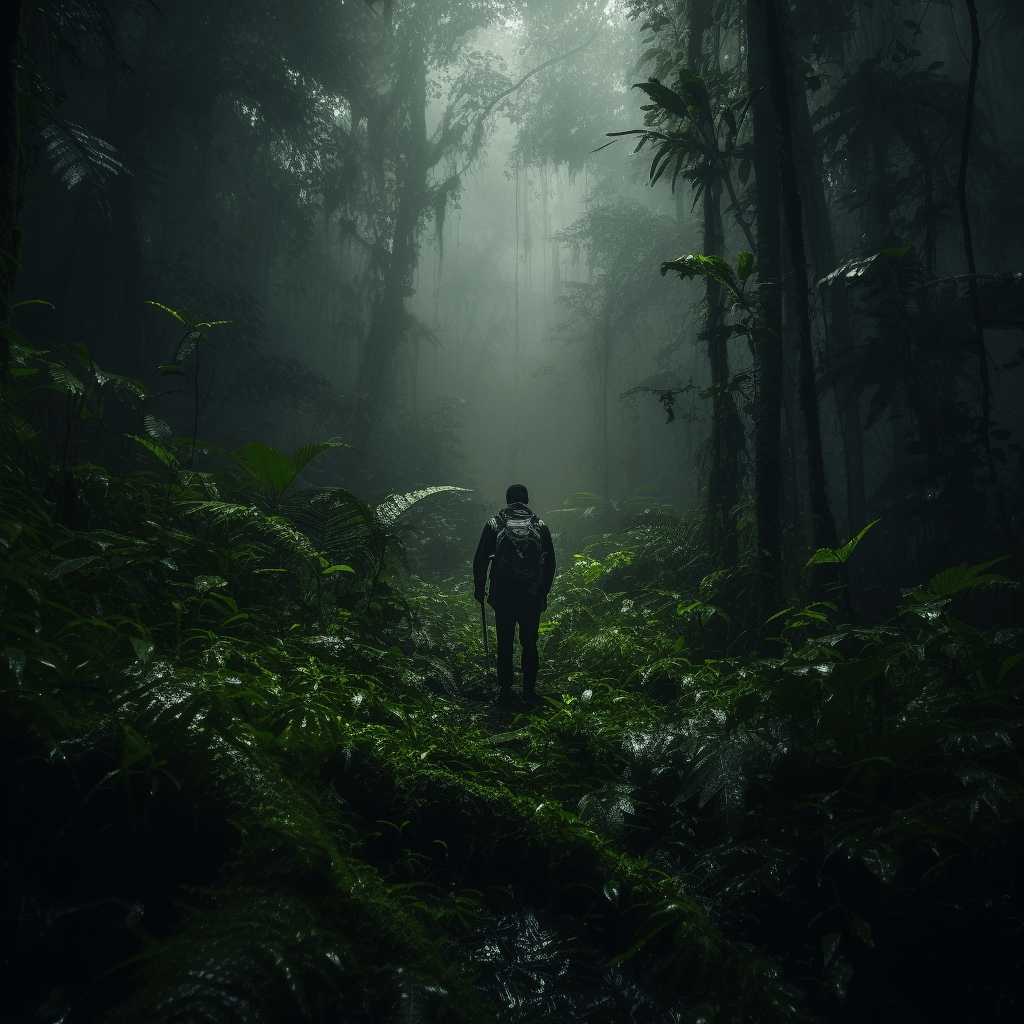
    /Imagine lost_hiker, jungle, dark, mist, cinematic, alone – by Midjourney | Chris Barclay

    People freak out when they get lost. They make bad choices. They walk in circles. In the jungle everything looks the same and the canopy makes dead reckoning impossible. So people just keep going, often in the wrong direction. Very few including me, choose to stay put, which is usually the best survival strategy.

    As I decided to quit my 8 km hike midway through, after hours of hacking through brush once I ran out of trail, I knew I had to come back across two rivers. The first crossing was deep in a rocky ravine. The second offered a shallow bed that ran more or less flat, so I jumped in and started wading through it, hoping to avoid the brambles and vines that had been entangling me all afternoon. While it saved me time bush-wacking, I became cold and felt I was heading deeper into unfamiliar terrain. So as darkness fell, I scrambled up an embankment and made my way toward a dense ridgeline where I thought I would be able to catch site of the village where I started out.

    I could indeed begin to see the twinkling lights of Royal Project greenhouses in the distant Hmong village, but they were at least 500 meters below. In a desperate scramble against the descending darkness, I down-climbed the steep hillside onto what turned out to be the edge of a sheer wall. Water pipes gurgling in some nearby brush led down from an impassable waterfall. I knew there had to be a legacy trail made by the team of villagers who did this irrigation work, but by then it was too dark to go further and risk falling.

    In the last moments of fading light, I edged my way down to a small pool just beside the waterfall and filled my water bottle for what was going to be a sleepless night. Everything was wet. I shivered beneath the plastic sheeting and began to regret not bringing even basic survival gear in my backpack. I thought of my wife and daughter, worried at home and having no way to contact me. Gazing out over the distant greenhouses illuminated in the valley below, I began to feel a sense of relief that at least I wasn’t far from people and hadn’t sustained any life-threatening injuries. All I had to do was wait out the night.

    As the moon rose through intermittent clouds, the jungle came alive with sounds, all of them new to me and none comforting. The startling chirps, hoots and screeches drew my thinking to how little I knew about where I was. I made two promises to myself: that I wouldn’t sleep or look at my watch. This gave me the whole night alone with just my thoughts. While the the first hour I dwelled on all the things I would have done differently and how I would a formulate a safe descent, my fatigue began to catch up with me. I stood gazing at the moon, rocking to keep my feet from going numb. I hummed to myself.

    At some point, I felt a presence. It was subtle and distant, but discernable. At first I thought in my exhaustion I was imagining things, or dreaming of rescue. But this was something in the background, and I heard it comforting me, as a parent would an injured child. This voice was mine, but it wasn’t coming from me.

    I had experienced such a voice before, coming down off an intense LSD trip. While the rational explanation is that this voice is a hallucination, an audible unconscious thought hoping to make sense of what just happened or self-soothe, it defies the way in which thoughts occur. We normally experience our mind as generative, making thoughts that our ego processes in terms of self-perception. This gurgling spring of unconscious thoughts bubble into the conscious mind, where the self forms ideas and beliefs around them. We pay attention to thoughts that reinforce who we perceive ourselves to be, then act in a way that’s congruent with this interpretation. If we act to the contrary or have an errant impulse, the mind corrects us by advising, “This isn’t you.” This process serves to keep us safe in our routines, protecting us from perceived danger, failure and humiliation, like getting lost in the jungle.

    In ill-conceived organizational brainstorming sessions, participants are often encouraged to “Think outside the box”, to somehow defy the constraints of our own thinking. But if all we have ever known is our own box, we also don’t know what we don’t know and struggle to conceive of possibilities outside of it. I believe we must first acknowledge that because it’s we ourselves who define the box, we are also free to redefine it. We can move the box or deconstruct it entirely. In other words, there is no box.

    The self believes it is always acting in our own best interest. It pays attention to things of perceived value, and interprets them in ways that prop up the walls of our box. Acting in congruence with who we believe ourselves to be is key to framing our reality and understanding how to navigate within it. The unknown world beyond is scary and overwhelming, so our minds are designed to constrain our perceptions accordingly.

    You are not a drop in the ocean. You are the ocean in a drop.

    Rumi

    Since beginning my psychedelic journey last year, I’ve come to realize that I am the box. This box is boundless and nameless, without time or distinction. I am one myriad reflection of the undifferentiated self. Nothing is happening to me because I am everything that’s happening.

    At this point you may be asking, Chris, if you’ve managed to raise your consciousness to such a degree, why are you freezing your ass off, lost at night on a mountain? Fair question. The universe is an infinite game and I enjoy playing it. Keeping the game in play means finding yourself and occasionally, losing yourself. It’s a never-ending game of hide and seek. This is opposed to finite games whereby we create win-lose rules that keep us in a state of constant competition with ourselves and others.

    The voice that assured me I had nothing to fear and would be guided to safety, might seem like it was just me comforting myself. And indeed, I had been reminding myself how lucky I’d been, having found my way to relative protection. But this voice came into my mind rather than from it, and spoke with a tone of relaxed confidence, as if already having witnessed my extrication. I believe this is Aldous Huxley’s Mind at Large, the unfiltered perception of wider planes of reality outside of our box.

    We’re connected to the Mind at Large, but normally unable to perceive it. Pychedelics, deep meditative states and life-threatening moments shut down the brain’s default mode network and open the ‘Reducing Valve‘ that constrains our awareness. We may experience a boundless state of being in which we become indistinguishable from everything else. From my own explorations, there is an overwhelming feeling of being loved; that the universe is on our side and is helping us in ways we cannot understand.

    Shivering in the dark up on that mountain, I began to quiet my mind and listen. In the moment that fear had subsided and I had stopped problem-solving, I felt the loving embrace of the universe. I remembered a future where I was safe and lived in abundance.

    The night passed so quickly, I was confused when dawn arrived. I thought it might have been a lucid dream, but then decided that I was actually observing daybreak. I looked at my watch and confirmed it was morning. I refilled my water bottle and began gingerly traversing the thick brush at the bottom of the wall. I soon discovered a water pipe running along the hillside, revealing an overgrown footpath. I followed it down, constantly entangling myself in wait-a-minute vines as I had the day before. I was walking away from the village but down the mountain, so I pressed on. The path hooked around, across a swampy ravine dense with banana trees, and onto a forested trail toward the greenhouses below. 30 minutes later I stepped off the terraced hillside and through the farms to the entrance of the village. I bought a bag of salted peanuts and a sports drink from a mom & pop store and charged my phone while I watched village children in lavender uniforms alight from pickup trucks and cross the street to school. I smiled at the simple beauty of it all.

    You are not controlling the storm, and you are not lost in it. You are the storm.

    Sam Harris, Free Will

  • A confining moment

    中文

    As social animals, people generally don’t respond well to confinement. That’s why it’s our primary form of punishment. It’s really the best disincentive to bad behavior we’ve come up with as a species. Lashings, public humiliation, attending traffic school, nothing makes people think twice more than the threat of being locked up. Which is why it’s understandable for people to be freaking out over current stay-at-home orders. It feels a lot like prison.

    Personally, this is my briar patch. 

    To be confined is to be kept within limits, but it’s totally up to us to choose how we relate to these limits. As Viktor Frankl wrote in Man’s Search for Meaning, “It is not freedom from conditions, but it is freedom to take a stand toward the conditions.” We are never more unfree than when we are trapped in our narrative of obligation, the dreary world of “I have to”. Now with many of our obligations gone, we have nowhere more to be than with ourselves, and for many, that is a scary prospect.

    If only life would slow down, we say, we’d be free to pursue the things we truly enjoy. A little peace and quiet would be nice. Now that time has arrived, and all this quiet is well, disquieting. We realize that being busy has let us off the hook for daring to examine what really matters. Because we’re secretly afraid that when we look deeply, we’ll either feel we’ve wasted our time in pursuit of those things that don’t matter, or we’ll realize that the things that do matter are too far out of reach. Confronting these questions about who we are is something so abhorrent to most people, we would rather do almost anything else than just be with ourselves. 

    So we look for excuses to keep busy and blame a new set of external circumstances for denying us what we deserve. I suspect the people who complain the loudest are the ones most afraid, because it avoids the risk of making new choices and being accountable for them. It’s much easier to look at a wide open highway and proclaim that it doesn’t go where we want and even if it did, there are too many unknowns. It’s the fear of freedom that keeps people truly confined. 

    While loss of income can be devastating, pulling out the rug of identity that comes from our work is equally if not more frightening. What we do keeps us continuously looking elsewhere for validation, recognition, and connection rather than from within. Yet it’s when we are deprived of resources that we become truly resourceful. We’re forced to look at things in new ways and realize we had the heart and brains and courage all along. 

    To be confined is liberating. 

    You may think as someone who writes about freedom that I’ve painted myself into a literal corner here, but hear me out. It’s a rare gift to have time with family, as well as the quietude to reflect and dream. Personally, we’ve lost all our income for the time being, but I can think of far worse things. We have food on the table, laughter in the house and an ease of togetherness that wasn’t there before. The freedom of confinement lies in the re-framing of “I have to be home with my family” to “I get to be home with my family”. Of course, my family may not feel the same way, but I’m enjoying the hell out of this.

    As someone who has always loved playing outdoors, this situation has caused me to temporarily shift priorities. But it is just temporary. There will be time for village walks, exploring goat trails and falling off my mountain bike in spectacular fashion. This is not a life sentence after all. I see this time as a gift – a rare opportunity to engage in unhurried reexamination without deadlines or expectation. It’s the opposite of punishment.

    Being on the clock is punishment, but one for which we are paid. This makes up somewhat for the perceived sacrifice of not being free to do what we want. With no pressing obligations, we’re suddenly open to set our own agendas instead of having them set for us. This can be scary, as we have no one else to blame if things don’t work out. If only we didn’t have to drive hours to our jobs, work overtime, pick up the kids from school and take them to soccer practice and do the shopping and attend teacher parent meetings. Well, now we don’t. Life has skidded to a halt and reveals itself to us in all of its beautiful stillness. The reasons we give ourselves for why we cannot achieve or feel or express what we want, are laid bare in these moments of splendid quietude.

    Not solitude but quietude. My family is here, my friends are here just over the virtual fence. I am restricted to my home but it doesn’t mean that my life is on hold. Quite the opposite, really. I’ve taken this opportunity to cliff dive into the harsh and unforgiving world of Javascript. It’s something I have no business doing. I’m not cut out for it, but what the hell. When you go all in to an endeavor at which you suck, even small progress is a real cause for celebration.

    I’ve had so many deeply invested plans and projects stymied one after another by this virus I’ve lost count. Oh, you poor thing, I can hear some of you say. Think of the lives lost, the homeless, and the heartbreak of lonely toll booth collectors. That’s real tragedy for you. I do realize the magnitude of it all and can’t forget for one minute how lucky we are. 

    Being grateful is key to the resourcefulness that leads us out of such a crisis. Despite all the #blessed people on Instagram wanting us to know just how well they’re doing, being thankful helps us out of the negative feedback loop it’s so easy to create when things go sideways. We’re hardwired for loss-aversion, fear and what’s wrong, so creating space for what’s right allows in light, to help us see what might be possible. As things fell apart, I began creating daily ‘wins’ out of simple routines. Make the bed? Win. Make a perfect cup of coffee? Win. Hugs and kisses? Win. I can never be tired of all this winning.

    I’m also finding communication to be richer and deeper than it ever was, maybe because the days are quieter. It’s helped me rediscover and appreciate the art of unhurried conversation. It’s like my eyes adjusting to the darkness.

    On those long, grinding commutes, what are the things we tell ourselves we want to do before we die? Write that novel? Learn to ride a unicycle? Take a selfie with the Pope? The confining moment determines much of how the rest of our life will go. It’s a snapshot of everything up until now and reveals what’s possible when we embrace the freedom to make new choices. The beauty of it is, we don’t have to do anything.  Confinement is our mind’s secret workshop, with just enough space to dream.

    The proper response to life is applause. — William Carlos Williams

  • On being Lisa

    It would be a lie if I told you that I am not scared. For me, the most frightening part of being smashed against the wall of mortality is the feeling that my life has been a failure. That I haven’t had enough time to realize all of my dreams and to make the kinds of contributions to the world that I always thought I would. — Lisa S. Keary

    My dear friend Lisa passed away last week in Chiang Mai after more than a year fighting lung cancer. During this time she wrote eloquently about her experiences in the course of her discovery, treatment and eventual surrender to the disease. She held a Ph.D with distinction from Columbia University and had a exemplary career in human rights NGOs. Lisa did make a great difference in this life and by the end of it, she realized that the things she had failed to achieve mattered less than being grateful for all that she had been given.  (more…)

  • Solve for X

    If attention is the currency of the internet, then anxiety is the currency of modern society. We are part of a massive, finely tuned anxiety machine that offers us the promise of freedom while churning out a dizzying array of choices that overloads our decision-making bandwidth, and distracts us from what really matters. More choice does not equal more freedom. 200 kinds of toothpaste do not make us free. When we are free, we recognize the difference between purposeful, self-owned choice and simply selecting from options presented to us. Freedom isn’t given, it’s taken, and extraordinary results come from managing the anxiety of freedom that is key to transformational change.
    (more…)

  • Rule #6

    The next time you find yourself ranting at salespeople, your mother, tech support, or other drivers, stop to remember rule #6. When I witness someone having a meltdown, it’s invariably because they have thrown rule #6 out the window. I’m guilty of such episodes, but at least I know the rule, despite a temporary lapse, and afterward I always feel foolish. You’re probably familiar with this rule already, though in the heat of the moment, it can be easily forgotten. Directly experiencing it is a revelation that can change your whole perspective on what matters. (more…)

  • Reckoning

    There’s a lot of apocalyptic chatter in the media these days, more so than usual. And you know it will only get worse as unscrupulous people seek to cash in on 2012 hysteria. This, in addition to the usual threats (anthrax, Jihadists, armies of the undead, and the ever-present menace of a robot uprising), has me somewhat worried. It’s not that I buy into the doomsday scenarios (there are plenty to choose from), but it has brought to my attention the need to be prepared when the merde hits the ventilateur. (more…)

  • In the shadow of leaves

    “We all want to live. And in large part we make our logic according to what we like. But not having attained our aim and continuing to live is cowardice. This is a thin dangerous line. To die without gaining one’s aim is a dog’s death. But there is no shame in this. This is the substance of the Way of the Samurai. If by setting one’s heart right every morning and evening, one is able to live as though his body were already dead, he gains freedom in the Way. His whole life will be without blame, and he will succeed in his calling. — Yamamoto Tsunetomo, Hagakure, “The Book of the Samurai” (more…)