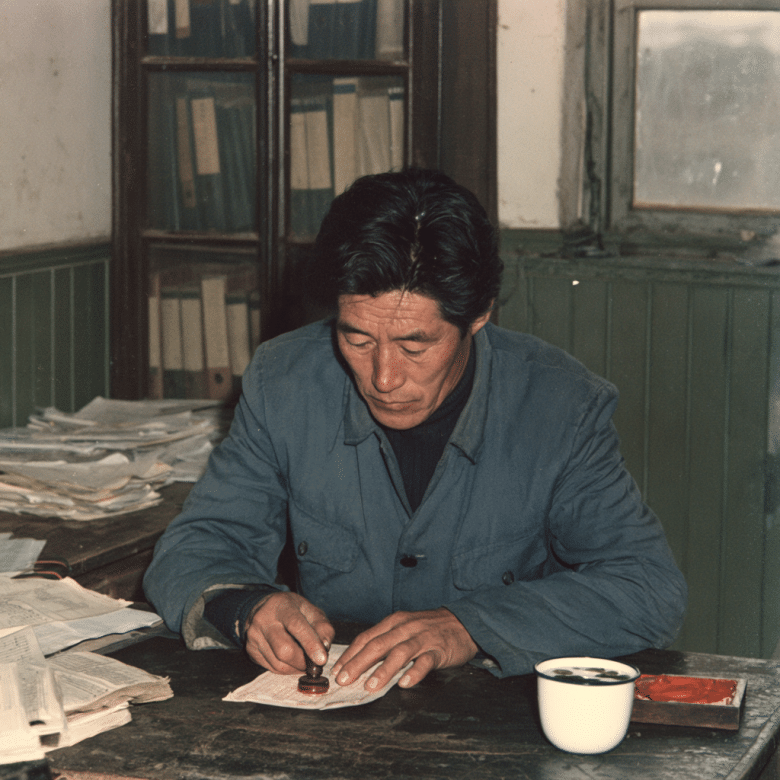
October 27, 1983 — Shanxi, People’s Republic of China
Deputy Director Guo is waiting in line to use the phone. It’s the third time this week he’s tried to reach Division Chief Deng at the Municipal Commerce Bureau in Taiyuan. The last two times Deng was in a meeting and despite the written messages left with his office, he didn’t return the call. Deng is dodging him. In line ahead of Guo is Manager Lu, who is having an animated conversation with a relative about a promised package that hasn’t arrived. It sounds like something he needs as a gift for his superior, though he doesn’t say so explicitly. The phone is in the administrator’s office and conversations are public. Guo takes his turn next, requesting a connection to Deng’s unit, handing the extension number on a slip of paper to the office clerk who eyes him silently. She winds the crank on the tabletop box and speaks to the exchange. After a moment she hands the phone to Guo.
“It’s Guo. I’m calling for Deng.” A silent pause.
“He’s inconvenient.”
Is he in the toilet? Is he dead? “What’s your meaning? I’ve been trying to reach him for a week.” Another pause, longer.
“He’s gone to study.”
He tries to read her tone. “Where?” Guo asks, turning away from the clerk and shielding the mouthpiece. “Is he in a situation?”
“I’m also inconvenient,” the woman says flatly.
“Shit,” Guo mutters, handing the phone back to the clerk who spins the crank again before putting the handset back in its cradle. If Deng had been sent to the cadre training school, she would have said so. More likely is that he’s being investigated or worse, detained. Deng was his inside man for acquiring a washing machine and owed Guo a favor dating back to 1980. How could he collect on it now?
Guo oversaw ration coupon allocation to local villages and townships in the Loufan County Bureau of Cereals, Oils and Foodstuffs. The distribution of eggs, meat, cooking oil, and grain was government controlled and required vouchers in state-run markets. A few privately-owned stalls accepting cash were popping up, but the vast majority of the population relied on precious coupons. The washing machine deal was the first in a series of important exchanges where Guo would barter industrial purchases with Deng.
It wasn’t above board, but Guo had his mind set on acquiring all Three Treasures of the new economy: a washing machine, a refrigerator and a television. These replaced the previous three: a bicycle, a sewing machine and a watch, all of which he already had. The easiest was the washing machine. It was the cheapest and if questioned, he could always say it was for the work unit’s guesthouse. He had his eye on a Little Swan brand made in Wuxi. It required a hose to fill but wouldn’t take up too much space in his small kitchen. With Deng out of the picture, Guo needed a backup plan.
After a lunch of fragrant pork with spring onion and a steamed bun, he walks back from the cafeteria to his cramped office and considers the next move. By 5:00 p.m., the tea cold on his desk, he has a shortlist of possible candidates for an exchange, one of whom he regularly meets at a nearby private eatery. He decides to ride over on his Flying Pigeon brand bicycle. The air thick with coal soot, he patiently pedals in a silent school of padded jacket commuters. As he passes the turn to his building he thinks of his wife: she would be preparing for dinner without him.
Just ten minutes down the road is the Convenient for the People Eatery; a squat brick shed with a corrugated tin roof. Perched on a dangerously steep slope, it is set back behind a muddy parking area and frequented by aggressive stray dogs. He parks the bike close to the door. As winter temperatures have arrived, two heavy black mats hang in the doorway to keep out the cold. He pushes through them and into the steamy, smoky dining room of bare cement floors and army green painted masonry walls, lit by a few fluorescent tubes. Tang is already here, a sometimes dinner companion from the Pricing Bureau. Unbuttoning his jacket, Guo greets him, taking out a pack of cigarettes and offering him one. Tang nods in thanks, placing it behind his ear, waiting to smoke until he has finished his plate of lamb and chive dumplings. He is drinking loose pours of fenjiu—a local sorghum liquor sold by the liang, fifty grams at a time.
Guo gets right to the point. “That deal I had, the one with the washing machine. It fell through.”
Tang’s mouth is half-full. “What happened?”
“Seems like Deng got pinched. I’m not sure exactly.”
“This is bad.” Tang leans in, lowering his voice. “He was going to get me a fridge.”
Guo pauses, realizing that he’s now part of a larger conspiracy. “Maybe you and I can work something out?”
Tang finishes his glass and wipes his mouth with his sleeve. “What are you offering?”
“Let me get an order in first,” Guo signals the cook’s wife who comes over in a dirty floral smock. “Beef noodle, and fenjiu. A new bottle.” She nods and shouts the order to her husband in the kitchen, startling a customer at the next table.
Guo continues quietly. “I have cooking oil coupons, around sixty liters worth. And flour—probably a hundred jin. I can have them to you tomorrow.” The bottle arrives with an extra glass. Guo pours the two drinks.
“I’d need all of it,” Tang says, lighting the cigarette.
“Fuck me, all of it?”
“I’m incurring more risk now. There’s a crackdown, if you haven’t noticed.”
Guo takes an impatient drink, realizing that a deal with anyone else will probably be even more costly, since at this point he can go through Tang directly. “Alright. Agreed. But the paperwork, it has to be complete. No missing stamps.”
“Understood. Twenty-four coupons. When do you want them issued?”
“At the earliest.”
“Why the rush?” Tang takes a drink as the wife brings Guo’s beef noodles. They wait for her to leave.
“I still need to collect enough surplus quota for a fridge and TV before Spring Festival.”
“You can find that many by the new year?”
“Not sure,” says Guo, blowing on the noodles held between his chopsticks. “But it’s only going to get tougher if I wait. And my asshole brother-in-law will be visiting with his loudmouthed wife. Last time he was boasting about his new Sanyo cassette player he got from a guy in Hong Kong.”
“Huh. Where does he get the tapes?”
“Fuck if I know. There’s nothing to listen to anyway.”
“Right,” Tang exhales thoughtfully.
Guo learned this racket from his predecessor. When people died or went into the army, he delayed filing the paperwork while their ration kept coming. He would then eat the empty quota. Then there was the spread between fixed price and market price for grain. Guo played the arbitrage and pocketed the difference. None of it could buy a household appliance. He still needed industrial coupons and was only issued two a month, while a washing machine cost twenty-four. He traded with men who could turn their coupons into what he needed.
Concluding dinner, the two shake hands and head into the soot-painted night. Guo feels unsteady on his bike after drinking but knows the road, even in the dark. He arrives home to his wife who is at the washboard and tub. “You won’t have to do that anymore,” he promises.
~
It takes three weeks for the Little Swan to arrive at the administrative office. Guo spots it on his way to lunch as the clerk is signing for it. She looks up in confusion.
“Did you order this?”
“Ah. Yes, the washing machine for the guesthouse,” he examines the delivery order. “Just leave it here. I’ll get someone to move it later.” His plan is to keep it in the crate for a week or two before taking it to his apartment. The guesthouse doesn’t have the water pressure or proper drainage, so he will take the machine on loan until the plumbing is updated, which could take years, if ever.
The refrigerator is a bigger challenge. For one thing, it costs a lot more. And it requires its own specific voucher that can’t be used for anything else. For this he needs someone higher up—Deng’s level—inside the Hardware and Electrical Bureau, who can move an allocation from another unit’s list to his own. It will take more coupons than he can acquire through current means. He’ll need a depot.
~
The grain depot at Miaowan Township is remote—remote enough that an inspection team would most likely skip it. Guo heads there in the unit’s rattle-trap minibus driven by old Liu. The ride takes almost an hour, over a brain-jarring route through the belly of the Lüliang mountains. Guo stops the bus twice to vomit.
They arrive in mid-morning fog, the depot’s concrete silo rises out of it like a faceless sentinel. The poverty of this village is hopelessly bleak, even for Loufan County, which itself is designated as impoverished. The two men exit the bus, Guo still feeling nauseous, as he walks through the mud to the depot office while old Liu takes a smoke break. The manager on duty is named Wu, though Guo has never met him. He greets the older man and offers him a cigarette, which Wu lights despite the ‘No Smoking’ sign in the office. The full ashtray reveals he has been persistently ignoring this warning. Guo asks him for the Loss Report and immediately questions the accuracy.
“You’re showing shrinkage of half a percent?”
“That’s right.”
“Why so low? You’ve got a lot of fog out here, a lot of moisture. The damp must ruin several times that.”
Wu spits a fleck of tobacco off his lip. “Nope. The silo is dry. No leaks. Nothing.”
“What about rats? You must have plenty of those. You’re surrounded by wheat fields.”
“Mmm, not so many,” assures Wu. “We set traps. And the cats get some as well.”
“Look,” Guo levels with him. “You must be under-reporting. The other stations are posting numbers of two and three percent. Yours looks suspiciously low. I don’t want auditors from the county seat to start asking questions.”
“I don’t want that either,” admits Wu.
“Right. So, my suggestion is we adjust this loss number to three percent and move out the ‘spoiled grain’, of which, I will let you decide what you want to do with your additional share.”
“Why would I want spoiled grain?”
“It’s not actually spoiled, Wu. But your number, as it is, looks like you’re hiding something. So I’m going to make the report in line with the other stations’ losses. Got it?”
“We’ll all show the same.”
“Exactly,” says Guo.
Next week a truck will quietly collect the phantom grain and take it into Taiyuan, to the warehouse of the Hardware and Electrical Bureau, whose section chief controls the refrigerator allocation. This simple handoff will get Guo his refrigerator before the end of the month.
On his way back to the bus, he stops in front of the shrine to the earth god. The simple breadbox-sized altar, blackened by decades of incense, sits modestly atop a one-meter concrete post. The Tudi Gong is the lowest-ranking deity in the celestial bureaucracy—the smallest god in the pantheon of Chinese folk religion. His jurisdiction is this field. Guo lights two cigarettes. Keeping one, he plants the other upright in the incense ash. He tells the little god, “You look after the field, I’ll look after the grain.”
~
It’s been three weeks. The refrigerator should be here by now. Guo leaves his mouse hole of an office during tea break to check with the administrative office clerk.
“Did we get a delivery recently?”
She doesn’t look up from stamping a pile of receipts. “Are you expecting something?”
“A refrigerator was ordered for the canteen,” he confirms, feigning only mild interest.
“Is it being shipped from Taiyuan?”
“Yeah. It is.”
“It might have been on the truck that went into the reservoir.”
“What? When did this happen?”
“The woman at the post office said two days ago. A total loss, but the driver survived.”
“Goddammit! Did they recover the bill of lading?”
“How should I know? You’ll have to check with the warehouse.”
He had ordered a Wanbao brand model with the light inside. It was in high demand and with the holiday approaching, almost impossible to replace. Guo curses the local geography, with its coal seam fires that burn underground for decades, the crushing isolation and poverty. The original town of Loufan was drowned when the government built the Fen River Reservoir in 1958. Guo’s refrigerator is now sitting at the bottom of it.
~
This loss puts Guo in a very tight spot. He can’t go back to the depot, he doesn’t have enough surplus allotment, and his inside man is literally inside—a detention center or worse. The TV seems an even bigger stretch; it costs a year’s wages for an ordinary official. For a good model, like the Shandong Taishan, he can’t just present coupons—he has to register in advance and wait his turn. He hasn’t seen Tang in the eatery for weeks, which is worrying, though it could be for any number of reasons.
Only one clear course of action remains: he will approach the Party Secretary directly, invite him for dinner, and personally ask for a priority allocation. The Secretary alone has the power to approve such a request. Guo will find a way to get the money. It’s risky, exposing his machinations, but he feels bold action is required.
Later that morning, Guo is waiting in line to see Party Secretary Ma. He recognizes the woman ahead of him from the Family Planning Commission. Her stony gaze meets his but both keep silent. It’s almost forty minutes and close to lunch before Ma is finally available.
“Deputy Director Guo, what brings you in?”
“An invitation.”
Ma gestures for Guo to sit. “What am I being invited to?”
“A dinner. With me. At a restaurant.”
Ma pauses and lights a cigarette, handing one to Guo. “Why not just tell me what this is about?”
“Well, that would spoil it!”
Ma cuts right to it. “Look, the admin office said you had a fridge on that truck that was lost.”
“What, that? It’s for the canteen.”
“Nevertheless, you requested it. Now, if you want it replaced…”
“Shit,” Guo thinks, knowing that he can no longer spring this on Ma as an offhanded request, even when he’s drunk. He lies. “My cousin, he’s bringing me a couple of bottles of Moutai. What’s better than sharing with friends?”
Ma’s eyes widen. “State banquet wine? He must be connected. Hard to get.” Ma does some quick math, stubbing out his cigarette. “How about this: I call a couple of friends over at the Commerce Bureau and we all go out together. Bring the bottles. We drink something else with dinner. Follow?”
Guo stands up a little too suddenly, as if trying to make a quick escape. “Yes, yes. Let’s do that! I’ll arrange everything.” He bows slightly and hurries out, his mind racing. It would be easier to get a new fridge than the Moutai on such short notice! He needs yet another plan.
At lunch, he looks down at the sad gray fish in his rice bowl. It’s reservoir carp for the second time this week. Why can’t the fisheries department stock anything else? He is agitated by the looming bribe for which he has no immediate source. He curses his luck. If not for the county’s backwardness, there would be safer roads and trucks wouldn’t tumble into the reservoir. Then the idea strikes him: if they can net carp, they can net a refrigerator.
That afternoon, a call to the Water Resources Management Bureau, with Guo’s promise of payment in kind, secures a rowboat and a truck with a winch. As it turns out, the lost cargo is in fairly shallow water, making the recovery straightforward. Three days later, Guo has his refrigerator back, albeit dented and filled with silt. His bureau has already written it off; no one will come looking for it. He has it brought to his apartment and carried upstairs, where his wife meets it with skepticism.
“Will this thing even work?”
“Why not?” Guo stuffs an old towel under it to absorb the pooling muddy water. “Just needs to dry out a little.”
~
His refrigerator now secured, Guo sets out to acquire his third treasure and the bribe required: the Moutai. He knows someone at the Sugar, Tobacco and Liquor Bureau, but what can he offer them? He looks at the documents on his desk. There is gold here, he thinks.
Liquid gold. The oil.
The county oil mill presses flax and rapeseed from surrounding villages, then stores it in their warehouse for distribution. The mill has a yield figure that Guo can manipulate. He does a simple calculation: if he can lower the yield by five percent, that allows him to allocate around eleven barrels of oil off the books. More than enough for the Moutai and new year gifts to his superiors as well. He’s pleased with himself. Guo sets up a dinner meeting at Convenient for the People with the relevant person, his plan too risky to discuss by phone.
~
Snow gathers on the little shrine in Miaowan. The country celebrates Spring Festival next week, welcoming the year of the Wood Rat. Guo is at peace. He sits watching TV, surrounded by a hundred other men, some known to him.
At the bureau, the telephone rings on the administrative desk. The clerk answers it.
“He’s gone to study.”
SUBSCRIBE TO THE AUTHOR ON SUBSTACK
https://savorybiscuit.substack.com