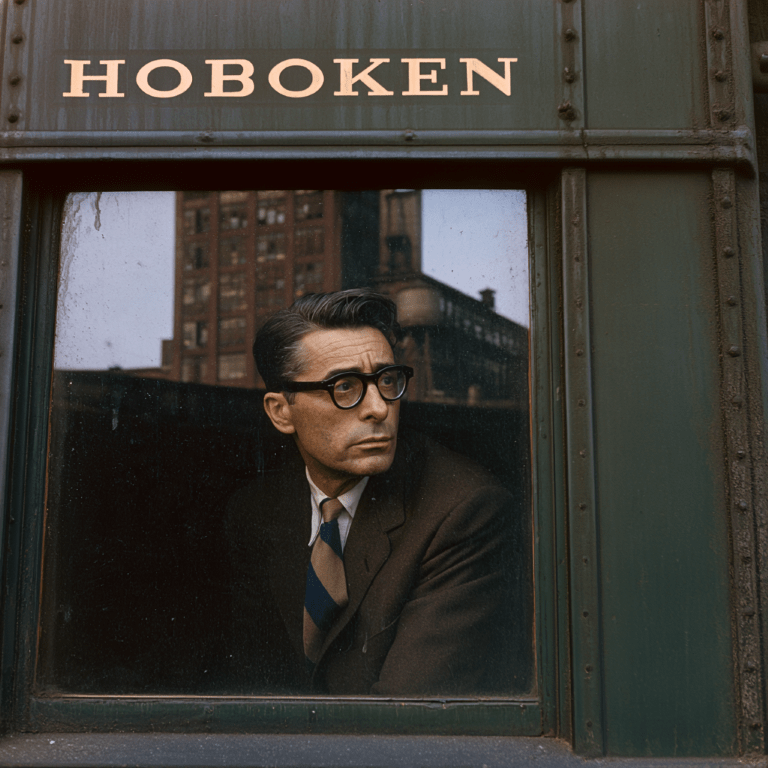
Tuesday, November 14th 1961
6:42 pm
Arthur Rosenfeld, a rising star actuary from Passaic Valley Mutual & Indemnity Insurers has a dental emergency. A cracked lower bicuspid, to be precise. It occurs over dinner as he bites down on an errant shard of bone in his wife Judith’s beef stew, exposing the nerve and causing acute pulpitis. It’s late and his dentist can’t see him until morning. Meanwhile, Judith has given him a cotton ball dipped in clove oil, whose numbing effect causes Arthur to drool involuntarily. He has also taken a Darvon—leftover in the medicine cabinet from his wife’s August gardening accident that required three stitches in her left thumb. The painkiller causes him severe dizziness and mental fog, rendering him incapable of delivering his speech at the Underwriters & Actuaries Annual Meeting the following morning.
At 7:18 pm, already impaired, Arthur phones his direct superior, Irving Gottlieb, Senior Vice President for Adjustments. Gottlieb, annoyed by the call which takes him away from his still unfinished New York Times Sunday crossword puzzle from two days prior, thinks the call is some kind of low-level prank. Arthur’s slurred speech makes him sound like a mental defective.
“State your business or clear the line, mister,” Gottlieb barks into the receiver.
“Is me, Mistah Galib. Artur. Artur Rothenfld.”
“Are you intoxicated, Rosenfeld?”
“Mah toot is bloken.”
“Your what, you say? Speak up!”
At this point Judith Rosenfeld mercifully takes the handset from Arthur and patiently explains the beef stew incident that set the whole disaster in motion. Gottlieb now recognizes the gravity of the situation. The Tri-County Insurance Underwriters & Actuaries Annual Meeting rules require that Passaic, Bergen, and Essex counties have equal weight on the stage. The minority report must be delivered by a Passaic County practitioner and Rosenfeld is Mutual & Indemnity’s only credentialed actuary. Gottlieb knows he must phone the Regional Chairman.
At 7:42 pm, when the phone rings at his home in Upper Montclair, Chairman Bob McAffee is locked in a battle with his RCA television. Seated on the floor, he is reaching around to the hot, dusty rear ventilation grid of the console, his pudgy fingers blindly adjusting a plastic potentiometer knob labeled VERT HOLD. Tuesday night’s broadcast of the Red Skelton Show is rolling repeatedly and aggressively from the bottom of the tube to the top. He is losing a game of microscopic adjustments, muttering obscenities under his breath and sweating through his white undershirt.
Taking the receiver off the wall, he is greeted by the panicked voice of Irving Gottlieb, who relays the seriousness of Rosenfeld’s dental situation and subsequent delirium. They review options: who at this late hour could agree to fill the seat for Passaic County? Gottlieb suggests Sheingart might have someone, though he can’t come up with a specific name. In desperation to clear the administrative bottleneck before morning, McAffee calls Morris Sheingart at his home in Paterson at 7:55 pm, pulling him away from the Make Believe Ballroom radio broadcast. McAffee’s appeal is clear and immediate:
“We need an alternate. Gottlieb has no one. If Sheingart Casualty doesn’t have a warm body to fill the seat by 9:00 tomorrow morning, the entire Northern District agenda is compromised.”
Morris Sheingart mentally reviews his roster. He can’t do it himself—he’s there to schmooze, not lecture on modern policy structuring, whose complicated math actually bewilders him. He needs a patsy: someone who is completely expendable. Someone whose absence from the office won’t disrupt the daily flow of new premium intake, but competent enough not to embarrass the Sheingart name. He thinks of Meyer Berkowitz, an inconspicuous accountant who hasn’t missed a day of work in twelve years. Meyer is the man who lives and breathes the actuarial tables. He will have to do.
~
Meyer lived in a modest three-bedroom Dutch colonial in the Eastside Park section of Paterson. He had been at Sheingart Casualty & Life for almost twelve years, but was still a Junior Accountant. His inability to curry favor with the company principals or drink with colleagues after work had made him mostly invisible. He had repeatedly been passed over for promotion, with younger accountants rising ahead of him. Despite his admirable work ethic, he was never considered a “go-getter” or someone invaluable to the organization. His book of business was primarily mortality tables and pensions.
Meyer is sitting at his dining table, reviewing the previous month’s water bill with intense scrutiny. The three-color punch-card statement reveals an alarming anomaly in usage from that of previous months. This makes him immediately anxious. He knows what the number should be. He has a mind for these things. For the past few years, billing was all done on automated tabulators and maybe the machine had made a mistake. DO NOT FOLD, SPINDLE OR MUTILATE it warns in bold text along the bottom, as if anticipating his growing frustration toward the card. His first thought is that there must be a leak somewhere. The house is only twelve years old. It doesn’t seem likely. There is no explanation for the surge in volume. He stopped watering the lawn back in early September and the household washing routine hasn’t changed. He was in the basement only yesterday to bring down laundry and hadn’t noticed anything amiss. He makes a note to check the water main, where the pipe comes through the cinderblock foundation wall of his unfinished basement. If the pipe has cracked inside the wall or under the yard, it will be a costly repair even with his premium home policy. He had opted for the higher deductible. Numbers like an airport arrival board click over in his head.
~
Morris Sheingart phones the Berkowitz home at 8:12 pm—a call that raises Meyer’s usual rumination on risk to an alarming new level. Sheingart anticipates his employee’s nervous constitution and attempts to make the call sound like a sweepstakes award notice.
“I’ve got great news,” he announces.
Meyer waits for the other shoe. At this hour?
“I couldn’t wait to tell you. You’ve been unanimously selected.”
“I’m selected? For what?”
“You’re the officially designated Passaic County representative for the Annual Meeting’s minority report tomorrow.
Meyer swallows hard. “Tomorrow?”
“Yes, yes. It’s quite an honor, Meyer. The votes just came in. Arthur Rosenfeld has a dental emergency and the committee voted for you to replace him.”
There it is—a last-minute act of desperation.
“How is this great news?” Meyer protests. “I haven’t had time to prepare anything!”
“That’s why you were chosen. Your sharp mind and quick wit! You’re the perfect fellow to share the latest market insights with us. A shoo-in, I told the committee.”
“And what am I to present exactly?”
“That’s up to you,” says Sheingart cheerfully, the clink of ice in a glass faintly audible over the line. “I’m confident you’ll come up with something. Well then, goodnight.”
As if on cue, Meyer’s wife Esther enters the kitchen in curlers and a pink chiffon nightgown. Noticing his pallor and morose expression, she is immediately concerned.
“Everything alright? Who was that?”
“Sheingart,” he mumbles, staring out the kitchen window, the punch card still pinched between his fingers. “I’m supposed to give a speech tomorrow.”
“That sounds like an opportunity,” she soothes, knowing he already doesn’t think so.
“It’s a disaster, is what it is. I don’t know how to face those people with nothing to say!”
“You’ve made a speech before.”
“At a briss. That hardly counts.”
She tries to be encouraging. “Let me make you a drink while you figure things out. I know you’ll do just fine.”
Meyer always keeps a bottle of Schenley blended whiskey in the cupboard. Tonight, he will drink two glasses over ice as he racks his brain for inspiration. With the first glass in hand, he kisses Esther goodnight and tells her not to wait up as he heads to his study.
He sits gloomily under the cased glass shade light of his Emeralite desk lamp, tapping his pencil nervously on a pad of lined paper. Nothing is coming to mind. He swirls the ice in his glass. He strums his fingers on the desk. He sips. He swirls. He looks at the spalling sycamore tree out in the yard, its bark peeling away in brittle, gray-and-tan scales to expose the bone-white wood beneath. Could its roots be growing through the water main? He thinks back to the water bill. He starts to feel hungry. He wonders if there is any leftover sponge cake from Esther’s neighborhood women’s coffee klatch.
Sponge cake.
Sponge cake. Wasserman.
Sponge cake. Wasserman. The Kiddush.
Yahtzee.
The Kiddush was the social gathering following Shabbat services at Temple Emanuel. It means sanctification in Hebrew, referring to the blessing over the wine that initiates the reception. This was the nerve center of local Jewish gossip in Passaic. Men talked about real estate, the decline of the local silk mills, the rising costs of labor, and the stock market. There was always sponge cake.
The room smelled intensely of brewing coffee, trays of pickled herring, and the floral perfume of the congregants’ wives. As a small-time actuary surrounded by wealthy textile executives and theatre owners, Meyer was always trying to glean a bit of insider knowledge to prove he belonged. Three weeks ago, he overheard something that would prove invaluable to solving his current crisis.
Meyer was standing near the edge of the social hall, holding a thick amber glass of Manischewitz that he was secretly worried might stain his tie. He was completely ignored by a circle of affluent men in J. Press suits. Among them was Jerry Wasserman, the phlegmatic deli owner, who was casually boasting as he precariously balanced a paper plate with a half-eaten square of sponge cake.
“My brother-in-law, he works in Met Life’s new department called EDP. They just bought an IBM Data Processing System so big it needs its own room. Each one of these things is gigantic—bigger than a Xerox.” He lowered his voice and leaned in. “This is hush-hush, but he says they work off a new math program they got from some wizards at Columbia. The formula tells you something called Human Capital Value. The machines figure out exactly what a man’s future paycheck is worth in today’s cash, and they peg the premium against the life expectancy of his career. He says it’s going to change the whole book.”
He took another bite of the sponge cake, and after a brief discussion in which the men wondered aloud what their deaths might be worth, talk turned to the new Paterson public tennis courts versus those at Preakness Hills.
Life insurance was simple and grim: mortality tables calculated when an average man would die. This new math treated a man like a depreciating corporate asset, reducing his future earnings to their present cash value. To the other executives, it was just cocktail chatter—a bit of gossip about data processing machines in New York. But to Meyer, lurking by the herring platter, it was an epiphany. His obsessive mind immediately linked human capital depreciation to the entropy he saw everywhere.
Thus inspired, Meyer gets to work on his speech, his Venus Velvet No. 2 pencil furiously scribbling the details of this radical idea. At the top of the page, in careful block letters, he writes the title:
THE PRESENT VALUE OF HUMAN LIFE
He continues:
The flesh is merely an uncollateralized loan—an amortization schedule written in blood and wood pulp.
Poetry. He calculates and refines the concept. None of it is his, of course. He got it from Wasserman, who got it from a brother-in-law in an obscure department at MetLife. But Meyer is among the first to hear of it, and hearing first is a kind of merit. He will be the man who brought the actuarial future to Passaic County.
Using himself as a statistic, he works out the numbers: Junior Accountant….forty-two….passed over twelve years running….salary flat….career life expectancy short….earnings growth rate….zero. The math is humiliating. He has just proven in pencil what he’s worth.
He briefly reconsiders his gambit. Maybe he can use someone else’s numbers? No. There’s no time for that. It must be him. He will stun the group with his revelation. His opening begins as follows:
If a man buys a twenty-year endowment policy at age forty-two, he expects a predictable universe.
~
The following morning, having only slept three-and-a-half hours, Meyer showers, dresses and appears at breakfast right at 7:05. He is wearing his tobacco-brown wool flannel suit from Barney Pressman, paired with a striped navy and tan rep tie over an Arrow starched white shirt.
Esther has made his usual: two perfectly poached eggs, two slices of buttered dark rye bread toasted to a standard crispness, and a cup of black Maxwell House coffee. She sips a frosted glass of reconstituted orange juice.
“Were you able to get some ideas on paper?”
Meyer gnaws at his toast as he speaks, conscious of the time. “I think I might have something big. We’ll see.”
“You always come up with a solution,” she smiles.
“I don’t want to put the kibosh on it.” He takes a swallow of coffee. “But this idea, it could shake things up for the company. In a positive sense.”
He hurries through the rest of breakfast before giving Esther a peck on the cheek and taking his Schoonmaker’s charcoal gray overcoat and matching porkpie hat from the front closet with mechanical, rehearsed efficiency. He will not read the paper on the train this morning; he needs to focus on his speech. Exiting through the garage, he pulls on his leather gloves and crouches down to grab the garage door handle. He tugs just enough to free the weatherstrip that’s stuck to the concrete pad from last night’s rime frost. His 1953 Plymouth Cranbrook is slow to start, but still reliable despite showing signs of wear. Most annoyingly, the rubber seals along the vent windows have dried out and cracked, creating a persistent, microscopic whistle at speeds over thirty-five miles per hour. Mercifully, his morning drive is just one and-a-half-miles to Paterson Station.
~
8:01 am
Meyer stands in the sharp autumn gusts on Paterson’s elevated commuter train platform, as the clang of the locomotive warning bell sounds. The creaking Pullman Green behemoth pulls in slowly, bathing commuters in the smell of sulfurous black industrial grease mixed with diesel fumes like the devil’s own breath. The violent clamp of iron brake shoes creates an ear-shattering squeal and the hot metallic smell of burnt-toast as the train rolls to a halt. The conductor opens the bodyside doors and announces, “Passaic! Passaic next! Change for the Main Avenue line! Have your tickets ready!”
Meyer steps into the ageing coach, instantly enveloped in the stifling steam heat smells of stale tobacco smoke, damp wool, and floor wax. The trip to Passaic is only fifteen minutes, so he grabs the heavy iron lever of the walkover seat back. The mechanism grinds through its rusted gears, until the backrest of the facing seat locks into place. He now has a makeshift booth to stretch out and review his speech without anyone sitting directly across from him. He removes his overcoat, folding it gently and draping it across his lap before he takes the papers from his briefcase, laying it on the adjacent seat with his hat on top. The short commute right to his office avoids the traffic and nightmarish parking of downtown Passaic, as well as reducing miles driven on the Plymouth, a fast-depreciating asset.
As the train leaves Paterson, he looks down on the historic brick raceway and vacant Passaic Worsted Spinning Company. He knows the landscape with a dull, aching familiarity. Just across the river stands Hird & Sons, virtually the only major woolen mill left operating in the city. Meyer sees the smoke coming out of their stacks and smiles slightly. It’s a rare holdout, still actively paying the worker’s comp and fire insurance premiums.
With just thirteen more minutes left on the trip, he reviews his notes. The light in the car is gloomy. He angles himself closer to the gray morning light coming through the sooty window to read his opening remarks. He feels strangely calm, as if this morning were just like any other.
~
As steam pipes under the floor warm his feet, Meyer notes the approach to Passaic: the S.S. Kresge five-and-dime and the Jefferson Bake Shop, with crowds packed on the sidewalks of Main Avenue. A scrum of Buicks, Fords and Chevys idles at the cross-streets, waiting for the flagman’s signal. Meyer gathers his overcoat and stands, steadying himself against the seat as the train lurches into the station at Main and Jefferson.
8:25 am
The conductor throws open the heavy vestibule doors and drops the iron footstool onto the concrete platform. “Passaic! All out for Passaic!”
Meyer steps off the train and immediately melts into the dense, bustling sidewalk crowd of shoppers and business professionals. The air smells faintly of industrial dyes and coal soot. Walking down Main Avenue, he passes Weisberg’s Luggage and Montauk Theatre with its faded marquee posters. He looks up at the towering brick facade of the shuttered Botany Worsted Mills on the edge of downtown. The water in the canal isn’t flowing; it is choked with green algae and floating islands of decaying wool fiber from the few remaining active scour rooms. Out of habit, he thinks to stop at Jefferson Bake Shop for a cinnamon rugelach and a cup of coffee to go, but realizes there will be plenty of baked goods and coffee at the conference.
The Tri-County Insurance Underwriters & Actuaries Annual Meeting is to be held at the Garden Vista Ballroom of the Passaic Elks Lodge No. 387 on Howe Avenue. The Italian Renaissance Revival lodge was designed to look like a European palace but has become a decaying monument to the industrial elite. Stepping through the heavy front doors, Meyer enters a broad marble-floored lobby with two grand staircases and heavy gold railings that sweep upward to the main ballroom doors. He heads to the staffed coat-check desk tucked beneath the curve of the left staircase, hands over his overcoat and meticulously files the wire-stapled cardboard claim ticket into his vest pocket while retaining his hat.
A large group of men mills in the lobby, mainly around the coffee urn and pastry table off to the right. Meyer scans for anyone he might know, but sees only vaguely familiar faces. He heads up to the ballroom, with its vaulted ceiling and massive crystal chandeliers casting a warm, incandescent glow. Decades of cigarette and cigar smoke from weekly Elks Club meetings have coated the prisms in a sticky nicotine film, creating a dull amber refraction. The dark-stained oak herringbone parquet groans under the weight of the two hundred accountants’ folding tables and chairs.
9:01 am
He places his porkpie hat on the empty chair next to him and sits at a table with one leg a fraction of an inch too short. He would slide a matchbook under it, but he doesn’t smoke. The table is draped in starched white fabric that is slightly askew. The laundry service used a cheap starch blend that shrank the warp but not the weft. Meyer thinks to himself, how can there be quality in anything when such details are left to chance? In front of him are a small amber glass ashtray and a phonebook-sized paper packet bound with metal brads. He takes out a tiny pocket sharpener for his Venus No. 2, catches the shavings in the ashtray, blows on the tip and sets the pencil perfectly parallel to the right of the packet.
Regional Chairman McAffee ambles to the front of the room, climbs three steps to the stage and stands under the tarnished crystal chandeliers of the Elks Lodge Ballroom. The standing audience members quietly take their seats. Conversations drop to a barely audible murmur. Meyer notices the continuous hiss and rhythmic clang of the boiler cycle coming from cast-iron radiators along the wood-paneled walls. The system is building too much back pressure in the return lines. He thinks of his water bill.
“Good morning. Good morning, and welcome. Before we get underway, we have a slight change in presenters today. Ahem. Arthur Rosenfeld is undergoing treatment for a broken tooth this morning. Fortunately for him, he has an excellent insurer and chose to purchase the dental rider.” Chuckles ripple through the audience. “We wish him a speedy recovery. In the meantime, I’m pleased to welcome our stand-in representative from Passaic County, who generously volunteered to speak in Arthur’s place. He is a longtime actuary at Sheingart Casualty & Life.”
For twelve years, the senior partners at the agency had looked past Meyer, preferring the flashier men who didn’t care about the warp and weft of the universe. But then the Regional Chairman, standing beneath the massive crystal chandeliers, clears his throat and reads a name from his three-by-five card.
“We will now hear the minority report on the revised mortality tables, presented by Mr. Meyer Berkowitz.”
Somewhere in Meyer’s addled mind, Copland’s Fanfare for the Common Man swells as he stands arrow-straight and strides with purpose to the podium. Silence follows, punctuated by an occasional cough and the rhythmic creak of his leather wingtips over the ballroom floor. A clang from the radiator. He settles in behind the podium, temporarily blinded by the smoky spotlight. A few whispers. He smooths his papers then downwardly adjusts the gooseneck microphone from McAffee’s height to his own. The PA system squawks, then hums slightly in its new position.
Another clang from the radiator.
He squints out at the invisible audience, cloaked in a haze of Lucky Strike and Chesterfield suspirations; the collective, tired breath of two hundred actuaries. Steadying himself, he clears his throat and slowly begins.
“Good morning. It’s an honor to present to you all today. I hope to leave you with renewed vigor in your pursuit of actuarial excellence.” He pauses for dramatic effect, then continues.
“If a man buys a twenty-year endowment policy at age forty-two, he expects a predictable universe.”
Without warning, a sound like tearing fabric fills the great hall, drowning the microphone’s ambient hum. Above him, the vaulted ceiling of the Elks Lodge Ballroom splits apart along the center seam, peeling back to reveal not the gray North Jersey sky but a vertical abyss of blinding, absolute white light.
The unearthly luminosity is terrifying, erasing all shadow. The hundreds of insurance men fall backward, their chairs clattering against the dance floor, their faces lit with uniform, breathless awe.
Meyer does not move.
He stands at the center of the radiating column of pearlescent light, his tobacco-brown wool flannel suit suddenly gleaming as if woven from luminous silver thread. The pedantic lines on his forehead smooth.
The endless, nagging noise of the leaking, crooked world falls still, resolved in pure luminescence. In a silent surge of divine clarity, Meyer Berkowitz is drawn upward into the absolute white void—promoted to a sphere where all measurements are perfect.
When the ceiling snaps shut and ordinary daylight filters through the clerestory windows of the Elks Lodge, the ballroom is silent. The stage is empty. There, resting precisely in the center of Meyer’s adjacent chair, sits his dark wool porkpie hat, without a single thread out of place.
SUBSCRIBE TO THE AUTHOR ON SUBSTACK
https://savorybiscuit.substack.com