Căușeni | April, 1993
It’s the morning of Blajini—a family picnic with the dead. Relatives have come to the cemetery in their visiting colors: pressed trousers, a good jacket, a bright head scarf and embroidered apron for the women. Knotted red and white memorial towels flutter from wooden crosses on new graves. The recently bereaved are in black, which they will wear for a year. The mood is surprisingly cheerful, even festive, while outside the gates, food and flower vendors ply their trade on the busiest day of the year. Mourners stream past graves carrying eggs, candles and bundles of pomană—offerings like pastries and braided bread for the deceased.
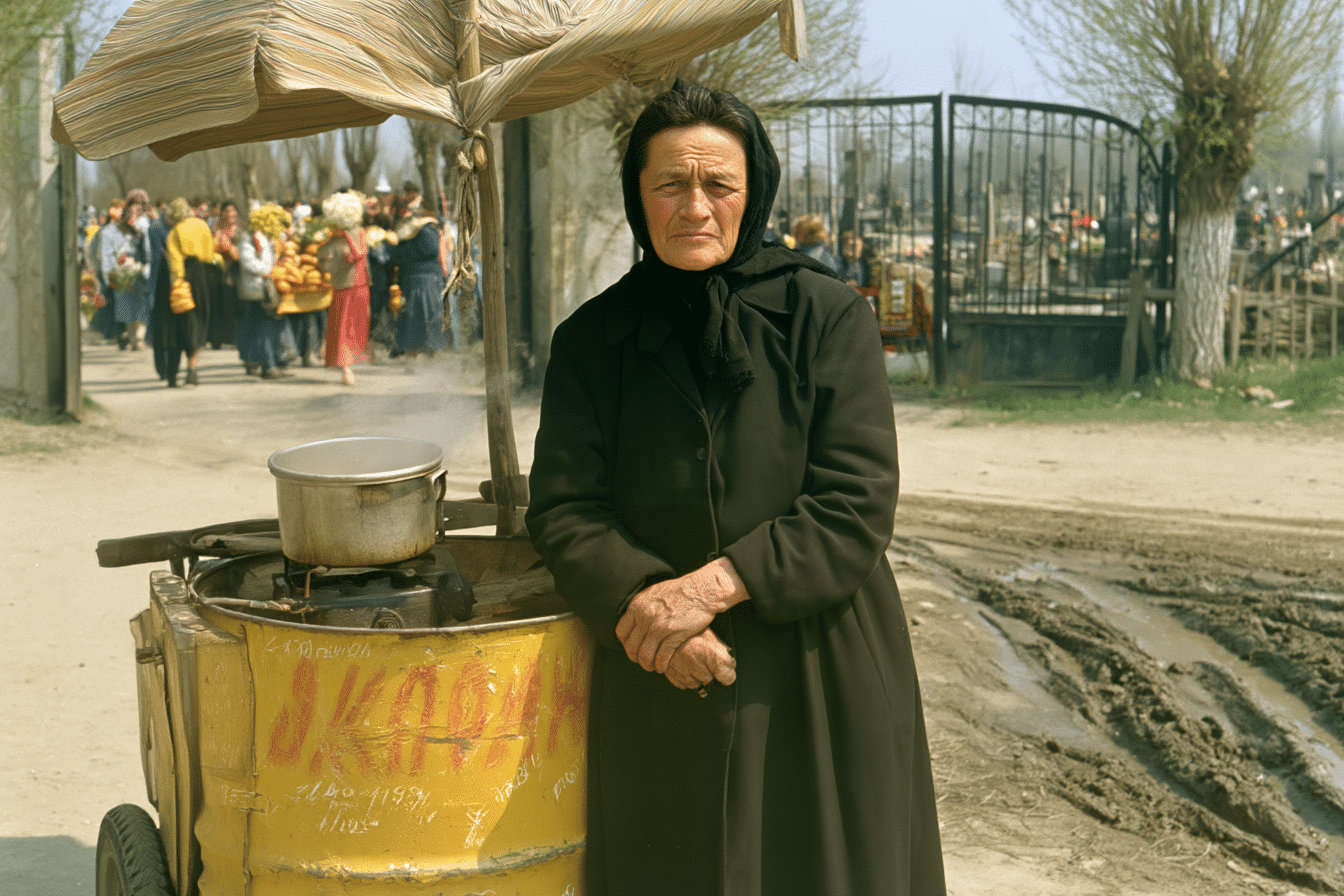 Standing out on the road in black is Aurelia—a widow who came to the cemetery early this morning to honor her son, Sergiu, killed by Russian-supported militias in nearby Bender. Unable to manage their small farm alone, she put together a simple street cart from an old Soviet kvass barrel on a two-wheeled trailer. She is selling plăcinte; flat pastries filled with potatoes and cabbage. It’s the best she can manage, though even on this busy day her sales are poor.
She is competing with several other carts run by women who have been in this business longer, and whose plăcinte is made with cheese and even minced beef filling. She doesn’t have the money for these higher quality ingredients, let alone a shop, nor can she cook particularly well. There must be something, she thinks, that can easily sell. But without special skills, what I can offer? When the holiday is over, she will focus on making the best gogoși: fried doughnuts with jam.
Three weeks later, she waits outside the school gates at 3:00 PM for children to buy her doughnuts. Despite the change of offering, Aurelia’s sales are still dismal. What kid doesn’t love gogoși, she wonders? But the students prefer packaged snacks at the kiosk. The boys especially like Turbo bubblegum from Turkey, each piece wrapped in a collectible insert with a picture of a car. They trade them like currency. There are expensive American candy bars that the children portion to share. All can be paid for in government cupons.
Aurelia is a keen observer. She notices that the children buy things they can put in a pocket or just pop in their mouth. She changes her snack offer yet again to poale-n brâu, (skirts tucked in the belt)—a square of dough folded over salty cheese, corners pulled to the middle. It’s a classic Moldovan snack. She will make them smaller, for a child’s hand, and charge a little less money. She believes this cannot fail.
Yet it does. The children turn up their noses at her bite-sized poale-n brâu. “I am cursed,” she moans. “How can such a simple thing be so difficult? I cannot get up early to make fresh snacks each day, only to eat them all myself!”
Her savings are gone. Much of it eaten by inflation after prices were freed. Her lifetime of careful deposits now buys a few kilos of pork. The widow’s pension is late and shrinking. Survivor benefits were promised, but come at a trickle and paid in cupon. The biggest drain is the memorial meals. Following a death, the family must offer pomană after three, nine, and forty days, again at six months, and a full year—feeding neighbors and giving away bowls, towels, and food each time. Skipping one is considered shameful. Preserving her son’s memory is expensive.
Beside herself with self-doubt and worry, Aurelia seeks the advice of Father Titi at the Church of the Assumption of Our Lady. As a senior parish priest, he is known to be a thoughtful problem solver. She goes to meet him at confession.
~
Aurelia steps down into the ancient sunken church and finds him at a lectern near the icons. She asks for confession and bows her head. Father Titi lays the end of his stole over her while she talks. Their conversation now private, she begins.
“I feel ashamed, Father, for after losing my husband and son, I have also lost my faith in the good Lord.”
“Jesus taught that faith as small as a mustard seed can move mountains, daughter.”
“I will remember these words,” she promises.
“Do not consider your problems so important before God,” he reminds her. “Each carries their own cross.”
“Yes. I know it, Father.”
“You are not a failure in the eyes of the Lord.”
“I have been diligent in my offerings and honest in my work. Yet I feel cast out. When I beseech the Lord, he does not answer me.”
“You know of God and Saint Peter walking the earth disguised as beggars? They knock on doors; the rich turn them away, the poor share their last bread and are rewarded.”
“I am nearly there. Soon I will have nothing.”
He lays his hand on her head.
“Lord, who fed the widow from an empty jar, look on your servant Aurelia. Give bread to her table and work to her hands. Rest the soul of your servant Sergiu where there is no pain and no sorrow. Doamne ajută.”
His words give her temporary comfort, and she begins to believe her patience will be rewarded.
~
That night, a thunderstorm shakes her house and she dreams of the prophet Elijah. His chariot of fire is a food cart, chasing devils with lightning. He stops at her window.
“Daughter, I have run out of mustard.”
Like the widow in the Scripture, she answers him. “As the Lord your God lives, I have only a little in a jar, enough for one.”
“Fear not,” he says. “Bring it to me first. For thus says the Lord: the jar shall not be emptied, and the barrel shall not fail.”
She passes the jar out through the window. He tastes some off his thumb and nods in approval. “Widow mustard seeks a bun. What the living will not buy will feed the dead.” He turns his cart toward the sky and is gone upward into the thunder.
Aurelia wakes up puzzled, not understanding the prophet’s riddle, but believing it is a sign. She will consult her older sister, Veta, who reads cartea de vise; cheap paperbacks sold at kiosks that interpret the objects of dreams. Veta consults the books with seriousness, though she is mostly wrong in a confident way. After a simple breakfast of tea and cold mămăligă—stiff cornmeal porridge from the night before, Aurelia walks ten minutes down the road to her sister’s.
~
Veta’s house is newer and decorated with flowers. There are a half-dozen brown goats grazing in the fields behind. Aurelia lets herself in and meets her sister in the kitchen where she is preparing sarmale, minced meat and rice wrapped in cabbage leaf, layered in the pot to simmer all morning. It is slow work, rolling and wrapping each piece. Without pausing, she asks Aurelia how she is getting along.
“Saint Elijah appeared to me in a dream last night. He spoke to me. I’m curious to know what his words mean.”
“What did he say?”
“He said something about mustard. There was also mention of bread. A bun, specifically.”
Veta turns to Aurelia. “For this, we should consult the book of dreams. Let me find it.” She quickly washes her hands, drying them on her smock as she goes out.
“I’ll make us tea,” Aurelia tells her, filling the kettle and moving it to the iron plate on the wood stove next to the steaming sarmale.
A moment later Veta returns with three books. “I brought a few in case the object is obscure. You said it was something about a moustache?”
“Mustard,” Aurelia corrects her.
Thumbing to the foods section, Veta offers her first interpretation. “Mustard. It means ‘bitter words from a relative.’ Did anyone in the family upset you recently?”
“No.”
“That’s odd. What were the saint’s words, exactly? Do you remember?”
“He said, ‘Widow mustard seeks a bun. What the living will not buy will feed the dead.’”
Veta looks at her blankly. “Widow mustard?”
“I assume he’s speaking of my homemade mustard. People have mentioned to me how much they like it. And in my dream, the prophet himself tasted it and seemed to approve.”
“So, you are the mustard-making widow in the dream. That’s clear. And the bread? Let me see what that means.” She flips the book closer to the beginning. “Bread is easier. It’s common. It means ‘a guest.’”
“What does it have to do with mustard?”
“It means you will quarrel with a visitor.” Veta is pleased with how quickly she found the answer.
“Why would Elijah reveal this to me?”
“It is mysterious,” Veta acknowledges, getting up and returning to her cooking. “Maybe you could bring your mustard to the Roma woman who reads cards at the market. She’ll take it as payment in kind and might be able to tell you more.”
Aurelia considers this. The sisters continue to talk about the local state of affairs, sharing gossip and Veta’s continued complaints about her husband’s drinking. Aurelia decides to return home early to fetch the mustard and take it to the gypsy woman. Leaving her house for town, the carpenter Ilie comes upon her with his horse cart and offers her a ride. He is delivering a coffin.
“Fa, Aurica,” he calls her from behind. She turns to see the cart with an old man being pulled by an even older horse.
“Uncle,” she greets him.
“Would you like a ride? If you don’t mind. I’m taking the coffin to Aunty Rotaru’s house. She just passed yesterday. There’s room for you on the bench.”
“Yes, my sister told me. Soon you will need one of these for me too.”
“Lord forbid it!” He admonishes as she climbs up onto the dusty plank opposite the pine box tied with rope and a small tin cross nailed to the lid. She holds her jar of mustard in her lap. The ride into town is jarring on the rutted road, the wheels dragging violently on muddy potholes. At least recent rain keeps away the dust, she thinks. She looks at the many fallow farms, absent the men killed in Căușeni District. Her son among them, she feels pity for herself. I must remember what the priest told me, Aurelia tries to quiet her mind. The mustard seed of faith can move a mountain. Think of how many seeds are in my jar? Surely with it I can move all of the Urals.
At the bridge over the Botna River, the cart slows to a stop and Aurelia climbs down, thanking the carpenter who carries on into town. Walking toward the market, she passes Ceban’s private appliance store, Euro-Tehnika, where a group of young people have gathered to watch a TV through the display window. She was never much interested in movies, but the dream has made her sensitive to any possible signs. As she stops at the window, she sees it is a movie that takes place in a big western city. A well-dressed man walks out of a modern office building and stops at a food stand. She cannot read the subtitles, but sees that the vendor prepares something like a sausage wrapped in bread and spreads mustard on it before giving it to the customer. Her eyes widen. She asks no one in particular:
“What is he making?”
“Khot-dog,” a boy answers.
“What is that?”
“It’s sausage in bread.”
“Like mici?” she asks, referring to the grilled local street food.
The boy shrugs. “Here, it seems the sausage is in a pot of water.”
“What place is this?”
“New York,” says a man. “It says in the words underneath.”
Stunned by the revelation, Aurelia thinks, how can it be that no one has a khot-dog cart in Moldova? Even in Kishinev, I have never heard of such a thing! And why would a rich city man in a fine suit buy one when he can afford a steak? It must be something very special that I am meant to see—like the prophet Elijah calling me to it. I will learn its secrets.
~
She begins her walk home, the jar of mustard still in her bag, unspent. She will visit the fortune teller another day. Aurelia repeats the prophecy to herself and seeks a bun. She can’t bake. Everyone in Căușeni knows it. She stops at the house of Domnica, the woman whose breads were the most popular during Blajini. She offers a trade: a jar of mustard for a batch of long rolls every week. The woman tastes the mustard off a spoon and agrees without bargaining. The only challenge left is the most expensive part: the pork. She knows how to make sausage like every village woman does at the Ignat slaughter: cleaned casings, minced pork, garlic, pepper. She has one pig, fattened for her son’s one-year memorial meal next year in February. His name is Ghiță. Each morning, she has carried him the kitchen scraps, even on days when there were hardly any. The pig meant to feed the town in her son’s memory goes into the casings instead. She does not tell anyone.
~
July 20, The Feast of Elijah
Ilie, on his name day, tows Aurelia’s cart to nearby Cîrnățeni, a village named for the sausages once sold to passing travelers. Today, villagers gather to worship at the church of its patron saint and enjoy the hram fair. At the morning Divine Liturgy, people bring baskets of the year’s first apples for the priest to bless with holy water. After the procession around the church, the music begins. Aurelia has positioned her cart between the wine merchants and pastry sellers. She will sell her hotdogs here. Revelers stop to read her sign:
hOT-doG
crenvurști în chiflă
“This is the food of the American rich,” she tells the curious. “It may look simple, but it is the favorite of New York businessmen. I can tell you, these carts are found outside glass skyscrapers to feed the bankers. I have seen it in the movie.”
Soon, she has stopped writing in chalk on her cart to keep track of sales. By early evening she has sold everything. It has been an exhausting and glorious day. With the money in her hand, she will stay the night in a relative’s home before going back in the morning. The cacophony of the fair behind her, she sleeps, and dreams of dancing pigs.
~
Căușeni | April 1994
A picnic with the dead has come again. Ilie towed her there. The line from Aurelia’s cart runs back past the gate and down the road. For the first time, she has painted the price on the barrel instead of chalking it. The cupon is mostly gone; replaced with coins that customers drop in her jar until it is full. Take this for Sergiu’s soul, they say. Inside the gate, the wooden cross that stood at his grave has been replaced by polished stone. On it rests a red stitched cloth with a single bun on top.
READ MY STORIES ON SUBSTACK
https://savorybiscuit.substack.com